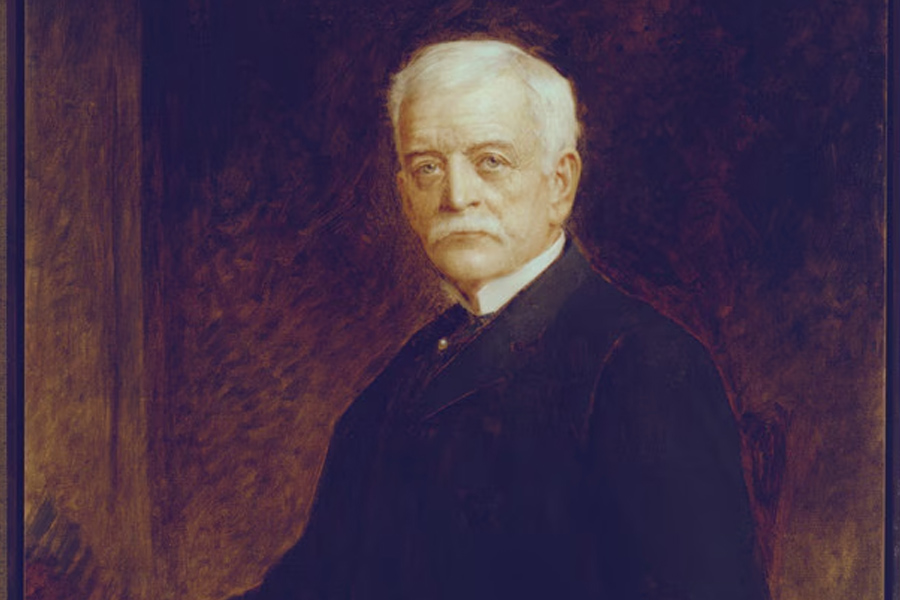
Basic Information
| Field | Details |
|---|---|
| Full name | Charles Henry Deere |
| Born | March 28, 1837 |
| Birthplace | Hancock, Vermont, United States |
| Died | October 29, 1907 |
| Deathplace | Chicago, Illinois, United States |
| Occupation | Industrialist, Business Executive |
| Major role | President of Deere and Company from 1886 |
| Marriage | Mary Little Dickinson, married September 16, 1862 |
| Children | Anna C. Deere Wiman (b. 1864), Katherine M. Deere Butterworth (b. 1866 or 1867) |
| Company output at death | Approximate annual business volume: $25,000,000 (1907) |
| Employees in Moline at death | About 3,500 |
Early Life and Family Roots
Charles Deere arrived in the world in 1837 and was carried west as an infant, planted into the rough soil of pioneer Illinois where his father had already planted a new idea in agriculture. He grew up amid iron, wood, horses, and the smell of hot metal. Schooling came in fits and starts: local schools, short stints at Iowa College and Knox College, and a 1853 diploma from Bell’s Commercial College in Chicago. At age 16 he joined the family business as a bookkeeper and learned the craft that would become his life.
Family shaped his work more than theory. He was the fifth child of John Deere and Demarius Lamb Deere. Loss and survival were constant motifs in the household: siblings who died young, sisters who married into local families, and a brother whose early death shifted the family’s hopes onto Charles. His marriage to Mary Little Dickinson in 1862 brought domestic steadiness and produced two daughters who later married men that would help guide the company forward.
Career and Business Expansion
Charles moved from ledger sheets to leadership in a manner that felt both inevitable and earned. He handled the firm through the Panic of 1857, made partner in 1858, and became an equal partner by 1864. Incorporation followed in 1868 with Charles as vice president, and in 1886 he formally succeeded his father as company president.
Under his stewardship the company shed the limits of a single works and became a national network. Branch houses were launched beginning in 1869 in Kansas City, followed by offices and agencies in St. Louis, Minneapolis, Omaha, and San Francisco by 1889. Product diversification multiplied: by 1907 the catalog included more than 300 plow models, 164 cultivators, and a range of planters and implements. Subsidiaries and partnerships expanded the product line and manufacturing base, including ventures into corn planters and other farm implements.
Leadership, Sales, and Innovation
Charles was not an inventor in the romantic sense; his genius lay in systems, distribution, and finance. He turned craftsmanship into commerce. Where his father had forged a better plow, Charles forged a better market. He emphasized sales techniques, practical demonstrations, and trust with farmers, often showing a plow in the field himself to win customers. He founded a company magazine in 1895 that later became a household name among farmers, a subtle but powerful channel for spreading ideas and building brand loyalty.
His financial prudence showed in survival and growth across boom and bust. He paid creditors in full during economic contractions, cultivated banking and railroad ties, and kept the firm solvent while scaling production. By the time of his death the firm’s annual throughput was reported as $25 million and the employee base in Moline numbered about 3,500.
Community Service and Civic Life
Outside the plant, Charles behaved as a civic steward. He served as a volunteer fireman as a young man and later financed firefighting equipment. He was involved in banking as president of a local bank, took director roles in utilities and railroads, and engaged in public projects such as canal advocacy and military arsenal support. Politically he leaned Republican, served as a delegate and elector, and represented local interests at international expositions in 1873 and 1893. His life in Moline read like a catalog of civic commitments.
Personal Life and Character
Private pleasures were modest. Charles loved horses, gardens, and calm domestic rituals. He and Mary lived in an Italian villa style house called Overlook and owned a houseboat named Time and Tide. He was described as reserved, democratic in manner, liberal in gifts, and quietly generous. The couple commemorated faith and charity in their church, and their daughters memorialized them in later renovations.
Family continuance mattered to him. Both daughters married men who later directed company affairs. Grandchildren and great grandchildren carried the Deere name into business, theatre, and public life. The family became more than pedigree; it was a living institution that perpetuated the company and its culture.
Financial Snapshot and Estate Notes
Numbers are sparse when it comes to personal net worth, but company figures sketch a silhouette. The firm produced about $25,000,000 in annual volume near the time of Charles death in 1907. Translating industrial output into personal wealth is imprecise, yet company control, stock ownership, and investments suggest substantial private means. He invested in land, local infrastructure, and civic institutions, leaving a material legacy in Moline without a single tidy figure for his estate publicly recorded.
Timeline
| Year | Event |
|---|---|
| 1837 | Born March 28 in Hancock, Vermont |
| 1838 | Moved to Grand Detour, Illinois as infant |
| 1853 | Graduated Bell’s Commercial College and joined family firm |
| 1857 | Managed company through financial panic |
| 1858 | Became partner |
| 1862 | Married Mary Little Dickinson on September 16 |
| 1864 | Became equal partner |
| 1868 | Company incorporated; Charles elected vice president |
| 1869 | Opened first branch house in Kansas City |
| 1872 | Built Deere-Wiman House |
| 1886 | Elected president after John Deere death |
| 1895 | Launched company magazine |
| 1907 | Died October 29 in Chicago |
Family Table
| Relation | Name and Notes |
|---|---|
| Father | John Deere, inventor and founder |
| Mother | Demarius Lamb Deere |
| Spouse | Mary Little Dickinson Deere |
| Children | Anna C. Deere Wiman; Katherine M. Deere Butterworth |
| Notable grandchildren | Charles Deere Wiman; Dwight Deere Wiman |
Recent Mentions and Living Memory
Family homes and gardens remain touchstones. Historic houses associated with the family are preserved as architectural and cultural artifacts. Seasonal events, restoration campaigns, and museum programming keep the personal story alive for visitors who want to walk the rooms and trace a family era. In modern media Charles appears mainly as the steady hand who translated a workshop into an enterprise that could weather storms and grow like a planted field.
FAQ
Who was Charles Deere in relation to John Deere?
Charles Deere was the son of John Deere and succeeded him in steering the family business into national markets.
What was Charles Deere most responsible for at the company?
He was responsible for sales, distribution expansion, financial management, and converting regional craft into nationwide industry.
When did Charles become president of Deere and Company?
He became president in 1886 after his father died.
How many children did Charles Deere have?
He had two daughters, Anna and Katherine.
Did Charles invent any agricultural tools?
No major inventions are credited to him; his strength was business strategy and market development.
Where did Charles live?
He lived in Moline, Illinois, and maintained residences including a villa called Overlook and a houseboat named Time and Tide.
How large was the company under his leadership?
By 1907 reported annual business volume was about $25,000,000 and the local workforce was roughly 3,500 people.
Are there preserved family sites today?
Yes, family homes and gardens have been preserved and host public events and restoration campaigns.