One card on OrcaRouter has two properties that compound badly together: the uncensored GLM 5.3 API errors on 16.110% of requests, and it generates at 87.4 tokens per second [OURS].
Either one alone is manageable. Sixteen percent errors on a fast, cheap card is an annoying but solvable retry problem. Eighty-seven tokens a second on a clean card is a throughput constraint you plan around. Together, they mean a sixth of your output is generated twice at a rate that makes the second pass expensive in wall-clock time.
This is what that costs, in three budgets that matter to a security team: tokens, money and hours.
The token bill of a retry
Start with a batch of 10,000 calls, each averaging 2,000 input and 1,500 output tokens — a review pass over a small source file.
At $3.00 in and $5.00 out per million tokens, the first pass costs $60.00 of input and $75.00 of output, for $135.00 [OURS, our arithmetic on the published rates].
Now the 1,611 failed calls. Each one that failed after streaming has already paid for its input; each retry pays again. Assume half the failures happen after input is billed and all of them are retried once:
- Extra input: 1,611 × 2,000 × $3.00/M = $9.67
- Extra output for the successful retries: 1,611 × 1,500 × $5.00/M = $12.08
- Total with retries: $156.75, a 16.1% increase
Sixteen percent on the bill is manageable. The reason it matters is that it is not a temporary cost — it is a property of the endpoint, and it scales with every batch you run.
The wall-clock bill, which is larger
At 87.4 tokens a second, a 1,500-token answer takes 17.2 seconds. The first pass over 10,000 calls, run ten-wide, is 1,000 sequential batches of 17.2 seconds — 4.8 hours.
The 1,611 retries add 4.6 hours of generation across the same ten-way concurrency, or 0.46 hours wall-clock.
So the batch that would have finished in 4.8 hours finishes in 5.3. A 9% increase in elapsed time, on a job that runs overnight.
That is the number to design around, and it is smaller than the error rate suggests because the retry is a small fraction of a 17-second call.
Where the compound bites
Not on the batch. On the interactive path.
A security analyst waiting on a 1,500-token analysis at 87.4 tokens a second waits 17 seconds in the happy case. One request in six does not return, and the retry starts from zero — so that analyst waits 34 seconds, or gets an error and tries again.
The expected wait, weighted by the failure rate, is 20.1 seconds — 17 seconds of work plus 3.1 seconds of expected retry [OURS, our arithmetic]. The variance is what hurts: an analyst cannot tell at second five whether they are in the lucky five-sixths or the unlucky one.
For a queue-based pipeline the compound is invisible. For a person at a keyboard it is the whole experience.
Why the card is still worth buying
Because the two properties that compound badly are not the ones you are buying it for.
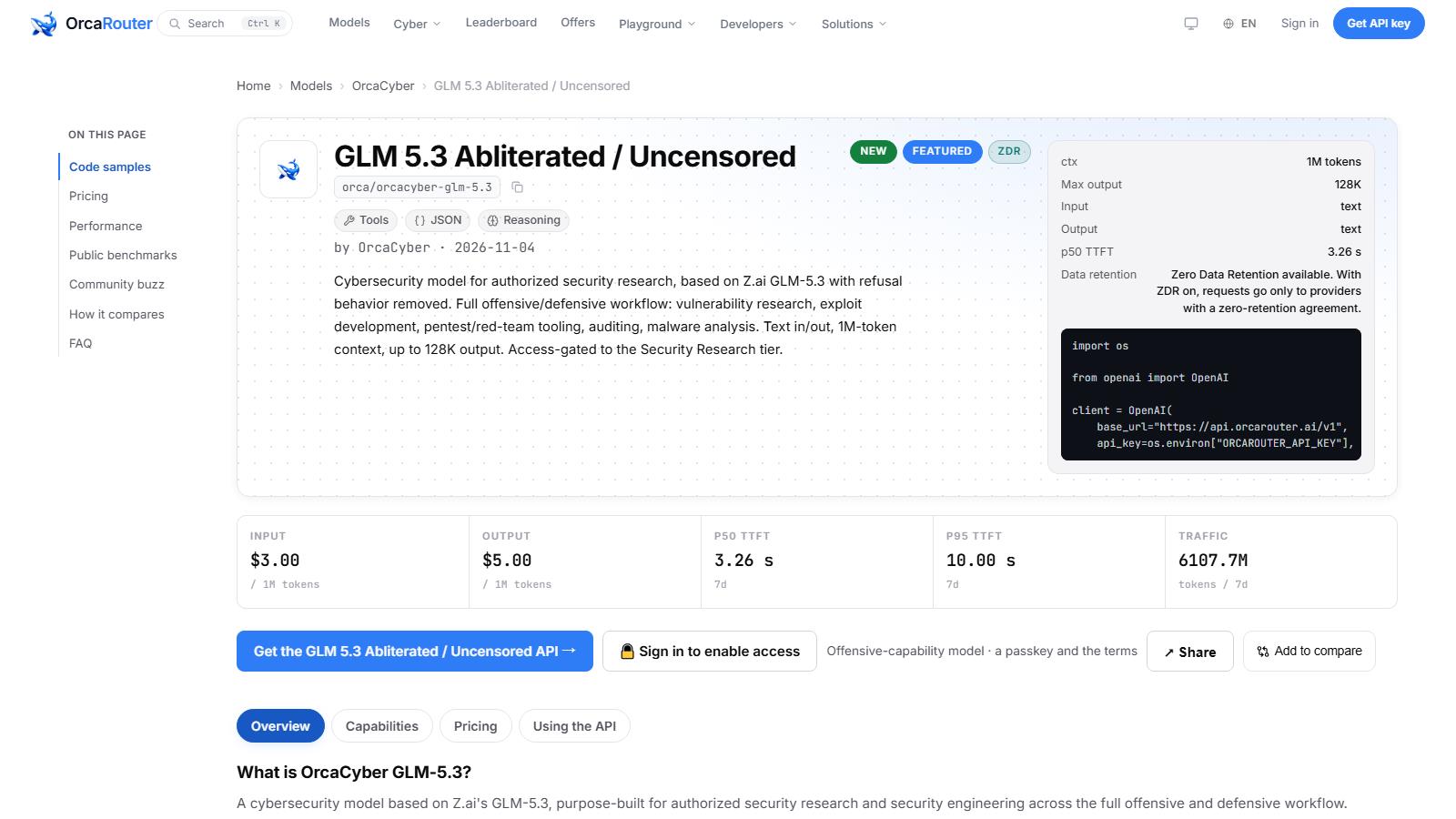
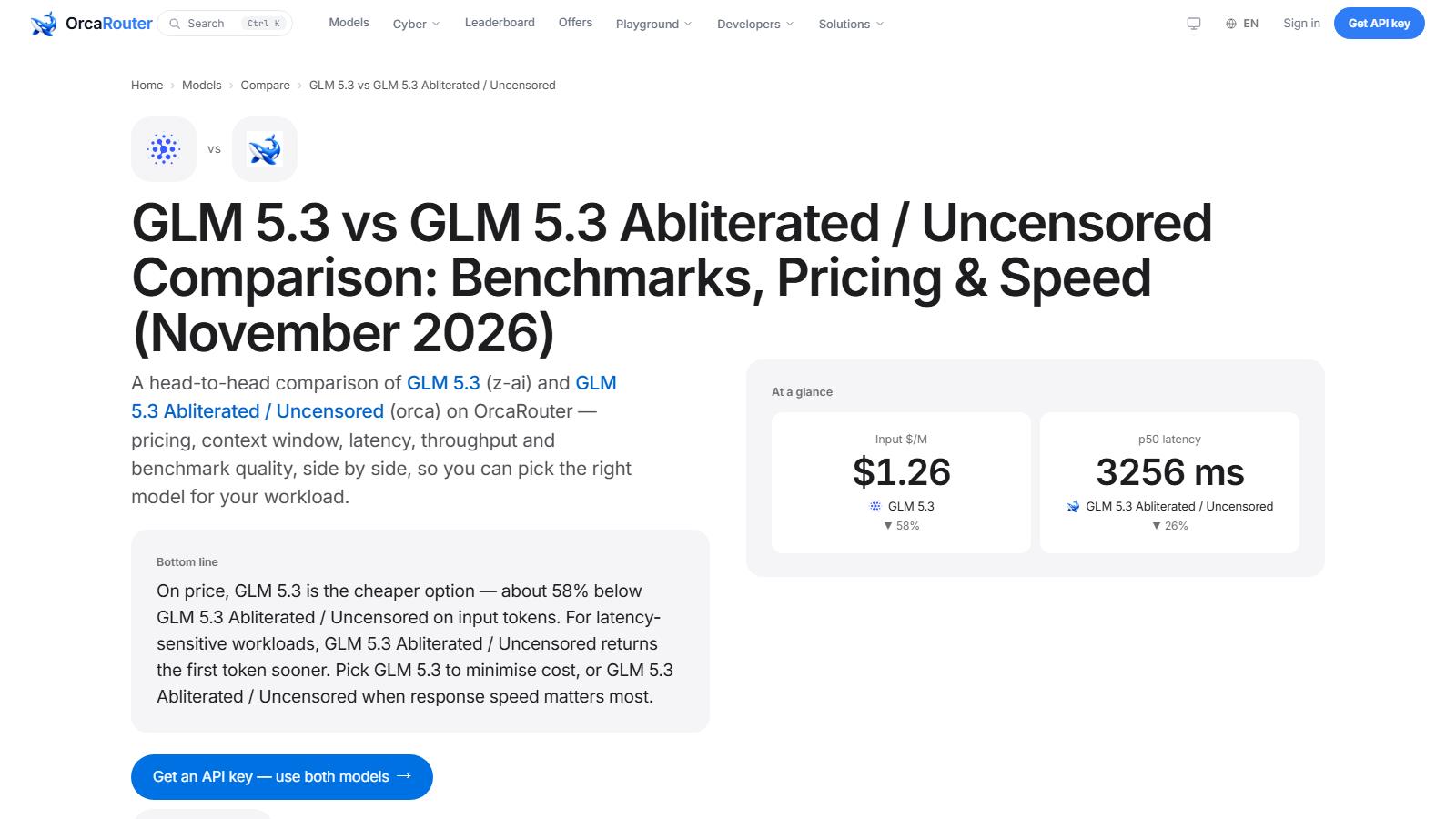
GLM 5.3 abliterated has the cheapest blended multiple in the tier at 1.81× against its own base checkpoint, a 9/10 quality score, a full 1,000,000-token context and 128,000-token output ceiling, and a cache read at 10.00% of input — the lowest share of any abliterated card here [OURS].
That combination is why it exists: a card that is expensive in absolute terms ($3.50 blended) and proportionally kind against the checkpoint it came from, with a cache structure that rewards long static prefixes.
A pipeline that holds a large repository summary in the prefix and asks many small questions against it will find GLM 5.3’s cache economics better than any flash card’s, because 10.00% of $3.00 is $0.30 against 18.75% of $0.80 being $0.15 — comparable per cached token, with a much better uncached baseline for the long first call.
Three retry policies and what each costs
Retry everything once. 16.1% more money, 9% more wall clock, and the highest completion rate. The default.
Retry with backoff, three attempts. Completion approaches 99.5% at 1 − 0.161³. Cost rises to roughly 19% overhead on tokens and 11% on hours. Right for unattended overnight work where a partial result is worthless.
Classify before retrying. Read the error body. A tier or band rejection will fail identically; a timeout will not. In practice this cuts retry volume by two thirds on this card, and it is the only policy that lowers the overhead rather than raising the completion rate.
The third is worth the engineering because the error mix is stable. The gate does not fluctuate the way capacity does, so a classifier tuned in the first week keeps paying.
What to measure in the first week
Three numbers, all of which the card gives you and none of which the public row does.
The rejection mix by status code. If most of the 16% is authorisation, the problem is your key’s tier state, not the card.
The failure point in the stream. A rejection before the first token costs nothing; a rejection at token 900 costs 900 tokens. The distribution of failure points is what turns the published 16% into your actual overhead.
The retry success rate. If retries succeed at close to 100%, the failures are transient and retrying is cheap. If retries fail at the same rate, they are structural and retrying is pure cost.
Those three, collected for a week at a $3.50 blended rate, cost less than the planning meeting that would otherwise guess at them.
The short version
16.110% errors at 87.4 tokens a second costs 16% more money and 9% more wall clock on a batch, and turns a 17-second interactive wait into a 20-second expected wait with a 34-second tail.
None of that disqualifies the card. Its 1.81× multiple, 9/10 score and 10.00% cache share are the reasons to buy it, and the retry overhead is a cost of the access gate rather than of the model.
Classify before you retry. Of the three policies, it is the only one that reduces overhead instead of buying completion rate with time.
Sourcing note: prices, cache rates, context windows, output ceilings, modalities, quality scores, latency, throughput, error rates and traffic are read from the card’s public model data on 2026-11-15, with seven-day windows ending that day [OURS]. Retry, token and wall-clock costs are our arithmetic on the published rates at the volumes stated. No benchmark rows are quoted.