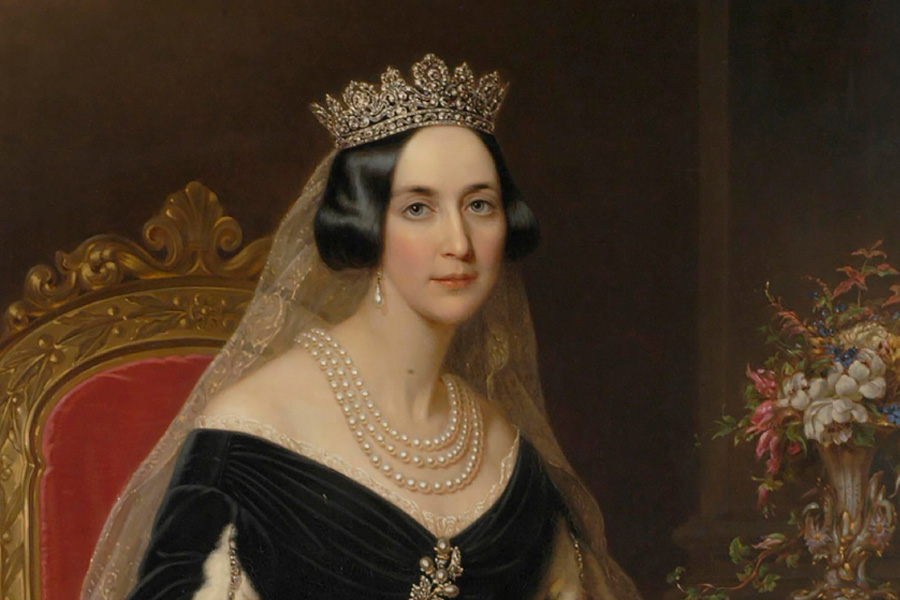
Early Life and Napoleonic Roots
I admire how history knits empires into monarchies. Josephine of Leuchtenberg, born in Milan, Italy, on March 14, 1807, personified the delicate weave. Her upbringing was filled with Napoleonic splendor and turmoil as the eldest daughter of Eugene de Beauharnais, Napoleon’s stepson and Viceroy of Italy, and Princess Augusta of Bavaria. Milan thrived until Napoleon’s collapse in 1814, when the family moved to Bavaria. Her grandfather, King Maximilian I Joseph, gave her father the Duchy of Leuchtenberg, turning exile into a glorious chapter.
Familiar with French, German, and Italian, she studied history, geography, natural sciences, mathematics, and physics. At 15, she met Crown Prince Oscar of Sweden on his European bridal tour in 1822. Their marriage was intentional, combining her Bavarian royal ancestry with Napoleonic prominence. Leuchtenberg Palace in Munich hosted a proxy marriage on May 22, 1823, before a June 19 mixed Catholic-Lutheran ceremony in Stockholm. She became Josefina in Sweden, overcoming widespread mistrust of her Catholic beliefs and French roots in a country ravaged by Napoleon.
Marriage and Queenship
I see her arriving in Stockholm like a fresh breeze stirring stagnant waters. After Oscar became King Oscar I in 1844, Josephine became Queen consort of Sweden and Norway until his death in 1859. Their love deteriorated due of his infidelity and her Catholicism. She outshines predecessors in charisma and public engagement. She had unusual influence as a consort after being crowned in Stockholm Cathedral on September 28, 1844. She consulted on the 1845 gender-equal inheritance law, prison improvements, and the 1846 guild abolition that modernized the economy.
Her advice helped peace efforts during the First Schleswig War in 1848. Her Catholicism was controversial in Protestant Sweden, yet she funded Stockholm’s first Catholic church in 1837 and others in Gothenburg and Oslo. This persistence, like a gentle river cutting stone, promoted religious tolerance and Catholicism’s legalization in 1858.
Philanthropic Endeavors and Achievements
Delving deeper, I see her philanthropy as a beacon in the shadows of 19th-century inequality. From 1826, she founded the Friends of the Poor Society for widows, followed by the Society for Tender and Proper Motherly Care in 1827 for impoverished mothers. In 1833, the Society for Work Encouragement emerged as a women’s employment agency, and later, the Crown Princess’s Handcrafts School for Poor Girls. As Queen Dowager after 1859, she established Josephinahemmet for elderly Catholics and King Oscar I’s Memorial Home for women. These initiatives, numbering over five major foundations, touched thousands, focusing on women’s and children’s welfare.
Her wealth, inherited from Napoleonic jewels like the Leuchtenberg Sapphire Parure and Cameo Parure, funded these causes. Valued in millions today, these pieces remain Swedish royal treasures, worn by descendants. Financial scrutiny arose in parliament, but her fortunes, though lavish, sustained her missions until her health waned.
Family Dynamics and Descendants
Family formed the core of her world, a bustling hive of royalty. With Oscar I, she bore five children between 1826 and 1831. Charles XV, born May 3, 1826, ruled from 1859 to 1872, though tensions flared over his recklessness. Prince Gustaf, the Duke of Uppland, born 1827, pursued music but died young at 25 in 1852. Oscar II, born 1829, succeeded as king from 1872 to 1907. Princess Eugenie, born 1830, became a philanthropist and artist, passing in 1889. Prince August, Duke of Dalarna, born 1831, lived until 1873.
Her siblings extended the web: sister Amelie, Empress of Brazil through marriage to Pedro I, died in 1873; brother Maximilian, 3rd Duke of Leuchtenberg, in 1852. Grandparents included Empress Josephine de Beauharnais, who died in 1814, and Alexandre de Beauharnais. Grandchildren like Gustaf V, King of Sweden from 1907 to 1950, and Louise of Sweden, Queen of Denmark, link her to modern monarchs such as Sweden’s Carl XVI Gustaf and Denmark’s Margrethe II.
Warmth marked her ties with father-in-law King Charles XIV John, despite religious divides. She nursed kin through illnesses, fostering bonds amid strains.
| Family Member | Relation | Birth-Death Years | Key Notes |
|---|---|---|---|
| Eugene de Beauharnais | Father | 1781-1824 | Napoleon’s stepson; Duke of Leuchtenberg. |
| Augusta of Bavaria | Mother | 1788-1851 | Princess of Bavaria. |
| Josephine de Beauharnais | Paternal Grandmother | 1763-1814 | Empress of France; Napoleon’s first wife. |
| Maximilian I Joseph | Maternal Grandfather | 1756-1825 | King of Bavaria. |
| Alexandre de Beauharnais | Paternal Grandfather | 1760-1794 | French general; executed during Revolution. |
| Oscar I | Spouse | 1799-1859 | King of Sweden and Norway from 1844. |
| Charles XV | Son | 1826-1872 | King of Sweden and Norway from 1859. |
| Prince Gustaf | Son | 1827-1852 | Duke of Uppland; musician. |
| Oscar II | Son | 1829-1907 | King of Sweden and Norway from 1872. |
| Princess Eugenie | Daughter | 1830-1889 | Philanthropist and artist. |
| Prince August | Son | 1831-1873 | Duke of Dalarna. |
| Amelie of Leuchtenberg | Sister | 1812-1873 | Empress of Brazil. |
| Maximilian de Beauharnais | Brother | 1817-1852 | 3rd Duke of Leuchtenberg. |
| Gustaf V | Grandson | 1858-1950 | King of Sweden via Oscar II. |
| Louise of Sweden | Granddaughter | 1851-1926 | Queen of Denmark via Charles XV. |
| Prince Carl Oscar | Grandson | 1852-1854 | Son of Charles XV; died young. |
Later Years and Legacy
In her dowager phase, Josephine retreated yet persisted. Health woes, from pneumonia to heart issues, shadowed her until death on June 7, 1876, at 69 in Stockholm. Buried in Riddarholm Church, her influence lingers in reforms and jewels.
Her gardening at Drottningholm Palace bloomed like hidden oases, and art patronage supported talents like Sophie Adlersparre. Introducing French customs softened Swedish court life.
| Timeline Milestone | Date | Details |
|---|---|---|
| Birth | March 14, 1807 | Milan, Italy. |
| Family Relocation | 1814 | To Bavaria post-Napoleon. |
| Meeting Oscar | 1822 | In Bavaria. |
| Proxy Marriage | May 22, 1823 | Leuchtenberg Palace. |
| Formal Wedding | June 19, 1823 | Stockholm. |
| First Child | May 3, 1826 | Charles XV born. |
| Philanthropy Start | 1826-1833 | Founded multiple societies. |
| Queenship Begins | March 8, 1844 | Oscar I ascends. |
| Coronation | September 28, 1844 | Stockholm Cathedral. |
| Reforms Influenced | 1845-1846 | Inheritance, prisons, guilds. |
| Schleswig War Role | 1848 | Diplomatic aid. |
| Husband’s Death | July 8, 1859 | Becomes Dowager. |
| Catholicism Legal | 1858 | Advocacy success. |
| Later Foundations | 1860s-1870s | Homes for elderly and women. |
| Death | June 7, 1876 | Stockholm. |
I find her story a bridge between fallen empires and rising kingdoms, her actions rippling through generations.
FAQ
Who was Josephine of Leuchtenberg’s spouse?
Josephine married Oscar I, King of Sweden and Norway, in 1823. Their union lasted until his death in 1859, producing five children and blending her Napoleonic heritage with the Bernadotte dynasty.
What were Josephine’s major philanthropic contributions?
She established several societies starting in 1826, including aid for widows, mothers, and women’s employment. Later, as dowager, she founded homes for elderly Catholics and women, impacting thousands over decades.
How did Josephine influence Swedish reforms?
As queen, she advised on the 1845 equal inheritance law, 1846 guild abolition, and prison improvements. Her diplomatic input during the 1848 Schleswig War helped secure peace.
Who were Josephine’s parents and grandparents?
Her father was Eugene de Beauharnais (1781-1824), Duke of Leuchtenberg. Mother: Augusta of Bavaria (1788-1851). Paternal grandmother: Empress Josephine de Beauharnais (1763-1814). Maternal grandfather: King Maximilian I Joseph of Bavaria (1756-1825). Paternal grandfather: Alexandre de Beauharnais (1760-1794).
What jewels did Josephine bring to Sweden?
She inherited the Leuchtenberg Sapphire Parure and Cameo Parure from Empress Josephine, valued highly today. These became Swedish royal heirlooms, worn by modern queens like Silvia.
How many children did Josephine have?
Five: Charles XV (1826-1872), Prince Gustaf (1827-1852), Oscar II (1829-1907), Princess Eugenie (1830-1889), and Prince August (1831-1873).
What was Josephine’s role in religious tolerance?
A devout Catholic in Protestant Sweden, she funded churches from 1837 and advocated for Catholicism’s legalization in 1858, facing criticism but advancing freedoms.
Who are some of Josephine’s notable descendants?
Grandchildren include Gustaf V (1858-1950), King of Sweden, and Louise of Sweden (1851-1926), Queen of Denmark. She links to current royals like Carl XVI Gustaf of Sweden and Margrethe II of Denmark.