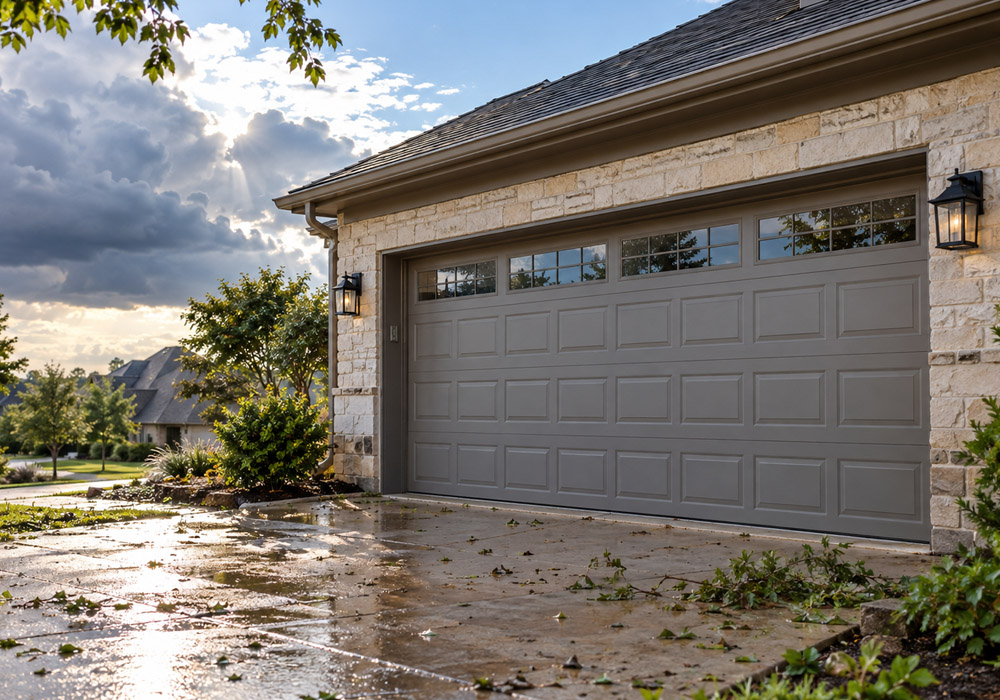
In North Texas, wind gusts, hail, and quick temperature swings can stress a garage door more than many homeowners realize. A sectional door is a moving wall made of panels, hinges, rollers, cables, and springs, all guided by steel tracks and powered by an opener. When storms roll through, weak hardware, dry rollers, or misaligned tracks can turn minor wear into a major failure. This practical checklist explains how wind and heat affect key parts, how to prepare a door before a storm, what to inspect afterward, and how to test operation safely without worsening the damage.
How Wind and Heat Strain a Sectional Garage Door
High winds push against the door like a sail, bowing thin panels and overloading hinges and struts. That pressure transfers to the top bracket and opener arm, then into the header where lag bolts can loosen over time. In Arlington, TX, heat compounds the problem: vinyl weatherstripping can soften and stick to the door, making the opener strain at startup, and dust can work into steel rollers and hinge knuckles, drying out lubricant. When tracks are slightly out of plumb, side loads increase, and rollers can ride up against track lips instead of rolling smoothly.
Consider a common storm scenario: the door is halfway open as a gust hits. The panels rack slightly, the vertical tracks flex at the jamb brackets, and a roller pops. Afterward, the door still moves, but it chatters and drifts to one side. Continuing to operate it can oval the hinge holes, crack a top panel around the operator reinforcement plate, or fray a lift cable at the drum.
Pre-Storm Steps: Reinforcement and Smart Preparation
Start by checking hardware that resists wind load. Confirm the top bracket and opener arm are secured with proper through bolts or lag bolts into solid framing, not drywall anchors. If your door has a long top panel, a continuous reinforcement strut across that section helps distribute load. Tighten loose hinge screws, especially around the center stile, and inspect jamb brackets that attach the tracks to the framing for movement or elongation. Lubricate steel hinges and roller bearings with a light silicone or garage door-rated spray, but don’t grease the tracks; they should stay clean and dry, so rollers track true.
Next, prevent operator-related failures. Test the safety photo eyes for alignment and clear lenses; sunlight glare and dust can cause false trips. If you plan to disconnect the opener, only pull the red emergency release when the door is fully closed to avoid a free fall. Never engage a slide lock while the opener is attached; a power surge or accidental activation can twist the top section or shear the opener’s internal gear. Plug the opener into a small surge protector and keep the area around the tracks free of stored items that could shift in the wind.
First Post-Storm Inspection: What to Look For Before You Hit the Remote
Step inside and examine the door in the closed position with the opener unplugged. Look for cracked or bowed panels, especially near hinge lines and strut fasteners. Sight down both tracks for bends, kinks, or gaps at the seams. Inspect lift cables for birdcaging, broken strands near the bottom bracket, or fraying at the cable drum. Scan the torsion spring above the door for a visible gap, which indicates a break, and check that the center bearing plate and spring anchor fasteners are still tight to the header.
Then move to the opener linkage. Verify the top bracket isn’t torn from the panel, the opener arm isn’t bent, and the header bracket is secure with appropriate lag bolts. Confirm photo eyes are still opposed at the same height and that their wires are intact along the wall. Inspect the weatherstripping and bottom seal for tears or sections pulled away from the jamb; hail can nick seals, letting driven rain reach steel components and inviting rust at hinge leaves and track flanges.
If the Door Moves Strangely: Safe Tests That Prevent Bigger Failures
Once your visual check is clear, run a few safe, basic tests. With the opener still disconnected and the door closed, lift manually by the handle. A well-balanced door should feel manageable and, when raised to about waist height, should not slam down or shoot up. If it drifts heavily or binds, stop; unbalanced torsion or extension springs need professional adjustment. Reconnect the opener and do a force reversal test by placing a flat 2×4 under the door; on contact, the door should reverse promptly. Finally, interrupt the photo eyes’ beam during closing to confirm an immediate reversal.
Avoid common mistakes that create bigger problems. Do not tape over photo eyes to keep the door running; that defeats a critical safety system and can mask alignment damage. Do not run the opener repeatedly if the door hesitates or the opener chatters; stripped drive gears and bent rails often follow. Never pull the red release cord while the door is open, as a free-falling door can damage panels, tracks, and anything below. If rollers jump the track, do not pry them back with the door under load; torsion spring energy can shift unexpectedly.
Long-Term Upgrades for a More Resilient Door
If storms are frequent on your block, plan incremental upgrades. Add reinforcement struts to wider or thinner panels, and install a heavy-duty operator reinforcement bracket on the top section. Swap worn steel rollers for nylon rollers with sealed bearings to reduce friction and grit intrusion. When replacing springs, ask about higher-cycle torsion springs sized for your door’s true weight. Consider a wind-rated door if your existing sections are flex-prone, and pair the opener with a surge protector and, if available, a battery backup to avoid mid-cycle stops during outages. The trade-off with added bracing is added weight, which requires proper spring recalibration to avoid overloading the opener.
Storm season garage door care is about timing and restraint: reinforce before wind arrives, inspect thoroughly before you press the remote, and stop at the first sign of binding or imbalance. A few minutes with a wrench, lubricant, and a careful eye on hinges, rollers, brackets, tracks, cables, and sensors can prevent panel cracks, gear damage, and dangerous drops. When in doubt, keep the door closed, leave the springs and cables alone, and schedule a professional evaluation so your door is ready for the next round of North Texas weather.