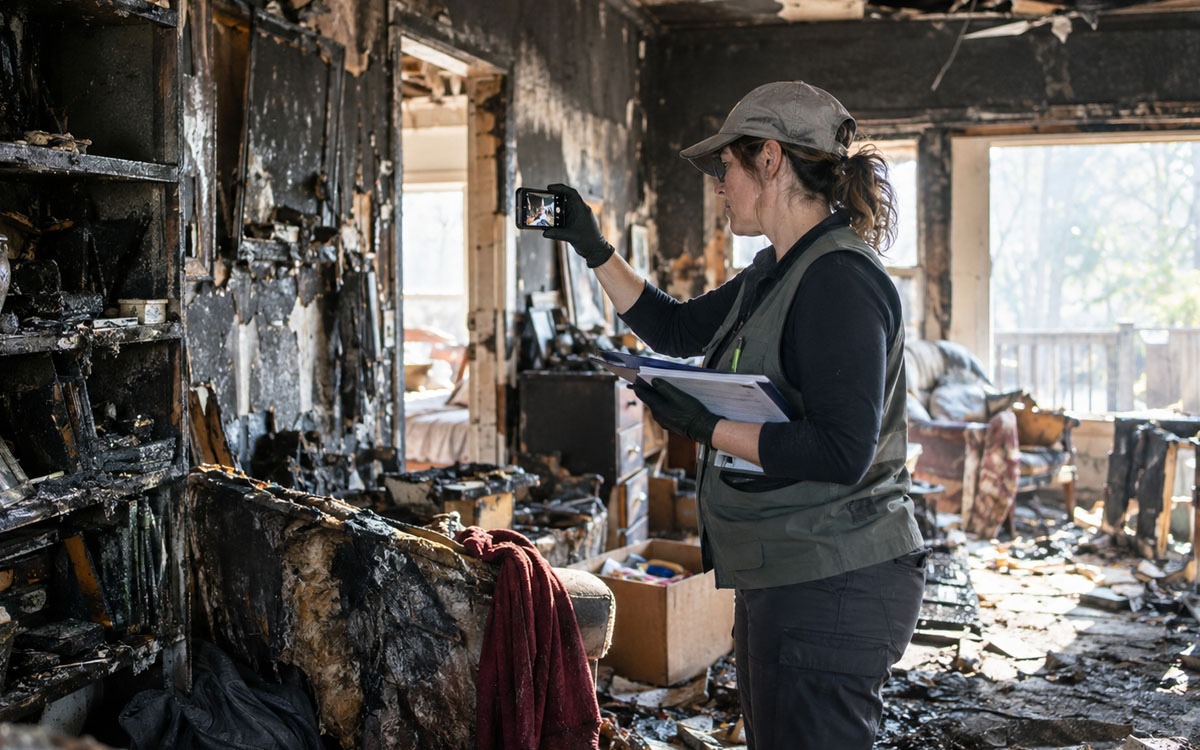
Not every fire claim follows a wildfire. Kitchen fires, electrical faults, appliance failures, and heating system malfunctions produce a large share of California’s fire losses, and these claims raise a different set of issues from a catastrophe event.
The central difference is contents. In a structure fire, the building damage is often the smaller half of the loss. What fills the building frequently accounts for more, and it is the part most likely to be underclaimed.
Why Contents Claims Fall Short
A fire damage public adjuster deals with the same pattern repeatedly on structure fires:
- Policyholders are asked to produce an inventory of everything lost, item by item, often shortly after a traumatic event
- Memory-based inventories miss a substantial portion of what was actually in the property
- Depreciation is applied to items where replacement cost coverage may apply, reducing the initial payment
- Smoke and soot affect items that never burned, and those items are frequently excluded from the claim entirely
- Specialist items such as tools, equipment, collections, and business property require valuation approaches that a standard inventory form does not accommodate
Smoke Travels Further Than Fire
Smoke and soot penetrate porous materials and move through HVAC systems into parts of a property untouched by flame. Textiles, electronics, documents, and building systems in those areas can all be affected. Because the damage is not visually dramatic, it is routinely omitted from insurer scopes unless it is specifically identified and documented.
California courts have recognised that damage caused by noxious substances such as smoke may qualify as direct physical loss under standard policy language [1], which gives policyholders a clearer basis for pursuing smoke damage as part of a fire claim.
Partial Loss, Total Loss, and Code Upgrades
Whether a property is treated as a partial or total loss changes how the settlement is calculated, and the boundary is not always obvious. Where reinstatement is required, building code upgrades triggered by the repair may be a covered cost under many policies, particularly in older buildings where current standards differ substantially from the original construction.
Public adjusters licensed in California represent the policyholder through this process [2]. Insurers must acknowledge a claim within 15 calendar days and reach a coverage decision within 40 days of receiving proof of loss [3], and a claim submitted with a complete contents inventory and full building scope is what makes those milestones work. Allied Public Adjusters handles structure fire claims across California, including contents-heavy residential and commercial losses.
Building the Inventory Properly
A workable contents inventory is built room by room rather than from memory in a single sitting. Photographs taken before the loss, purchase records, bank and card statements, delivery confirmations, and insurance schedules for higher-value items all help reconstruct what was present. Where a room is accessible, working through it systematically, including storage areas, cupboards, and garages, consistently produces a longer list than recollection alone. The difference between a memory-based list and a reconstructed one is frequently substantial.
Common Questions
Are smoke-damaged items covered if they did not burn? Often yes. Smoke contamination can constitute physical damage, though the extent must be documented and, where appropriate, tested.
What if the contents inventory was submitted before items were remembered? Supplemental contents claims are common and can be filed where additional losses are identified after the initial submission.
Key Takeaways
| 1 | In structure fires, contents often represent the larger share of the total loss. |
| 2 | Memory-based inventories consistently understate what was actually in the property. |
| 3 | Smoke and soot damage items that never burned and is routinely omitted from insurer scopes. |
| 4 | Building code upgrade costs may be covered where repairs trigger current standards. |
| 5 | Supplemental contents claims can be filed after an initial inventory has been submitted. |